
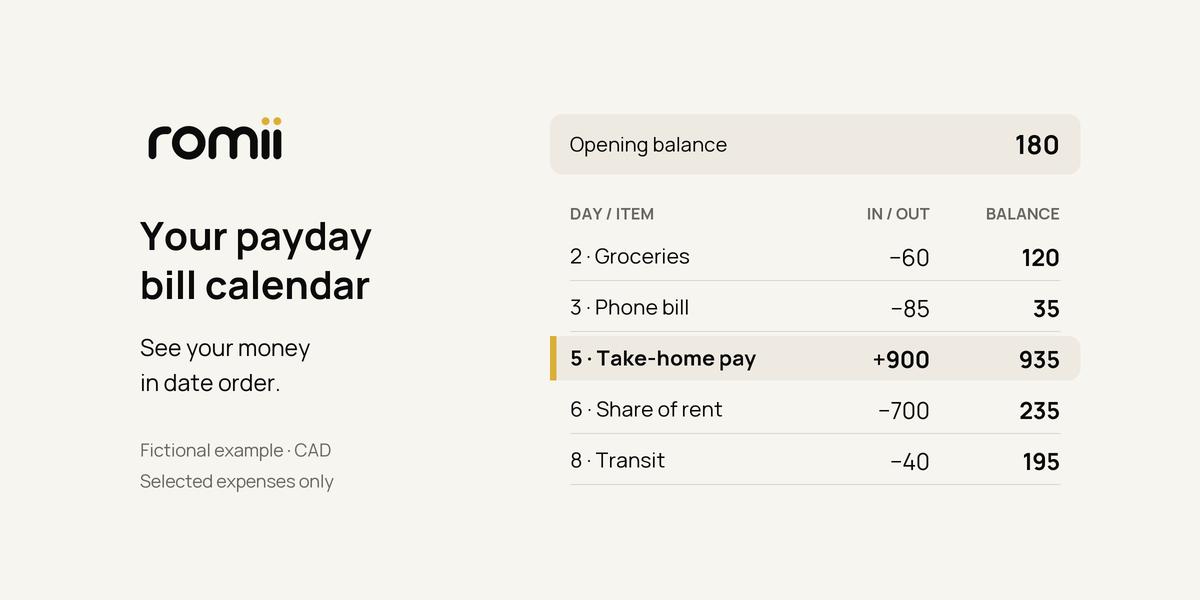
If a bill is due before payday, make a simple calendar of the money you can use now, the payments coming up and the dates your income will actually be available. Work through those entries in date order to see where your balance gets tight. If the money will not cover a payment, that gives you a specific amount and date to discuss with the bill provider before it is due.
You can do this in a notebook, a notes app or a spreadsheet. The aim is to make the next few days easier to see.
Start with the dates, not just the monthly total
You might have enough income across a month and still face a difficult few days between a bill and your next pay. That is a timing gap.
A different problem arises when your income repeatedly cannot cover your necessary expenses, even after payday. Moving dates around will not close that ongoing shortfall. A calendar can help you describe it, but you may need a broader plan and support.
For that wider view, the Financial Consumer Agency of Canada's guide to making a budget explains how to bring your income, savings and expenses together.
Put four things on your calendar
Choose a period that includes your next income date and the important bills just after it. Then gather:
- Money you can use now. Start with available cash, excluding overdraft or credit and deposits still on hold. Note pending transactions. If a purchase is already reflected in your starting balance, do not subtract it again.
- Payments already scheduled. Include rent, phone bills, automatic withdrawals and other commitments. Record both the due date and when money needs to leave your account. Check any payment-processing time with the provider.
- Essential spending between bills. Groceries, medication, childcare or transport may not have an invoice, but still need room in the plan. Use an estimate based on your own needs and recent spending.
- Income and when you can actually use it. Record expected take-home pay, rather than gross earnings. An invoice sent or a shift worked is not money available today. Mark uncertain amounts or dates as estimates.
Keep incoming money and outgoing payments as separate entries. If several happen on the same day, do not assume the income will be available first.
Copy this simple calendar entry
Write your opening available balance once. Then copy this entry for each income or expense:
- Date money is available or leaves the account: [date]
- Item: [pay, bill or essential expense]
- Money in: CAD [amount, or 0]
- Money out: CAD [amount, or 0]
- Expected balance afterwards: CAD [amount]
- What needs checking: [date confirmed, amount estimated or provider contacted]
For each entry, add money coming in to the previous balance, then subtract money going out. An expected balance is a planning figure, not confirmation that a transaction has happened.
A small example, in Canadian dollars
This example is entirely fictional. Every amount is in CAD. It shows only selected expenses over eight days, not a complete household budget or recommended spending amounts.
The opening available balance is CAD 180. These are the planned entries:
- Day 2 — Groceries: CAD 60 out. Expected balance: CAD 120.
- Day 3 — Phone bill: CAD 85 out. Expected balance: CAD 35.
- Day 5 — Take-home pay: CAD 900 in. Expected balance: CAD 935.
- Day 6 — Share of rent: CAD 700 out. Expected balance: CAD 235.
- Day 8 — Transit: CAD 40 out. Expected balance: CAD 195.
The arithmetic is 180 + 900 − 60 − 85 − 700 − 40 = 195. That remaining CAD 195 is not necessarily spare money: this short example leaves out other expenses and later bills.
What if a date changes?
If the pay arrives on Day 7 instead of Day 5, only CAD 35 would be available before the Day 6 rent payment. Against CAD 700 due, the plan shows a CAD 665 gap. It does not show the rent being paid or assume an overdraft will cover it.
The same gap appears if rent is due on Day 4 and pay remains on Day 5. The monthly totals have not changed, but the order matters.
Ask early when a payment will not fit
If your calendar shows a gap, contact the bill provider before the due date where possible. You could say:
“My bill is due on [date], and I expect my income on [date]. Are there any payment-date changes or arrangements I could discuss?”
Ask what any arrangement would mean for the amount owed, possible charges and future payments. A provider may not be able to change the date or offer an arrangement. Keep the original entry until a change is confirmed, and save that confirmation.
For difficulties involving a financial institution, FCAC also recommends making contact early to ask what options are available.
Update the plan when life changes
When pay is delayed, a bill changes or an unexpected essential expense comes up, update that entry and recalculate everything after it. Replace estimates with confirmed amounts as you receive them.
If necessary expenses still do not fit, you do not have to work through the situation alone. In Ontario, 211 Ontario can connect you with information about social services, programs and community supports. Availability and eligibility depend on the service.
A useful calendar should reflect your situation, even when the numbers are uncomfortable. Seeing the gap clearly gives you something concrete to work with and explain when asking for help.
A little room, right on time.
Romii is in development, starting in Ontario. Applications are not open yet. You can get to know Romii and the experience we're building.
This article provides general financial education, not advice tailored to your circumstances.