
If a bill lands before your income does, you can ask the company that sends it whether a different regular due date is available. Start with the bill in front of you, say which date you are hoping for, and ask exactly when any change would begin. A request is not an approved change: keep planning around the current due date until the provider confirms otherwise.
This conversation is about the bill's terms and timing. It is different from moving a reminder in your own calendar or scheduling a bank transfer for another day. If you need to see the gap first, use our payday bill calendar. If your income arrives every two weeks, our biweekly pay guide helps you reserve money across paycheques.
Get the facts from your bill
Before contacting the provider, note the account reference from your latest statement, the amount currently due, the existing due date, and any payment already scheduled. Decide on a proposed date that fits your actual income dates and leaves time for the payment method you use. You can keep sensitive account details out of an ordinary email until you are using the provider's verified contact channel.
It helps to name the problem plainly: “My bill is due on the 3rd, and the income I use to pay it arrives around the 7th.” Those dates are an example, not a claim that a provider will offer the 8th or any other day. If you are already behind, mention that at the start so the provider can explain options for the existing balance separately.
A script you can use
“Hello. I’m checking whether my regular bill due date can be changed. My current due date is [date], and I can usually pay after [income date]. Is [requested date] available for this account? If it is, when would the change take effect? Please tell me what is due on the current bill, what the first bill after the change would cover, and whether any charge, interest, or other term would change. I also have [a pre-authorized debit / a bank payment / another method] set up. Would its withdrawal or processing date change? Could you send the details in writing?”
For a message, remove the details you do not need and ask the provider to use its secure channel for account verification. For a call, write down the date, the representative or reference number, and what they said. Ask them to repeat any date or amount that is unclear.
The Financial Consumer Agency of Canada advises people managing debts to contact creditors to discuss their financial situation. Its guidance does not establish that every bill provider can move a recurring due date. You are asking what this provider offers for this account.
Check the handoff between the old and new dates
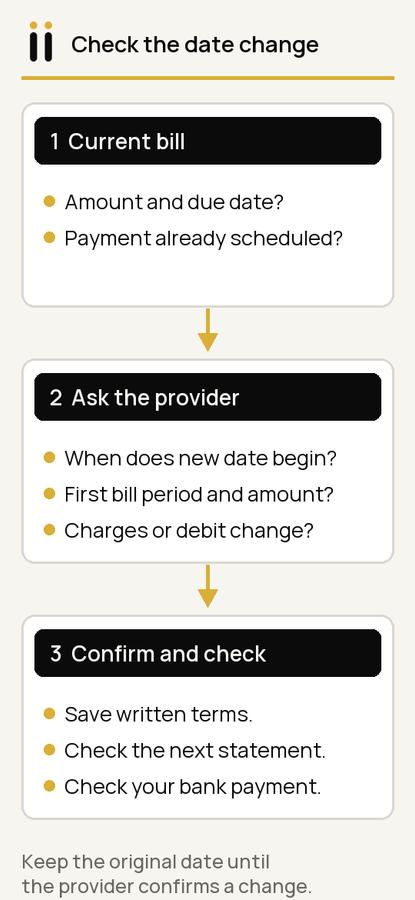
The first bill after a change can be the confusing one. Ask these questions before you rely on a new schedule:
- Current bill: What amount is still owed, and on what date?
- First changed bill: What period will it cover, when will it be issued, and when must it be paid?
- Future bills: Is the new date recurring, or is this a one-time payment arrangement?
- Cost and account status: Would the change affect the amount, interest, charges, service, or any existing arrangement? If the answer is unclear, ask for the applicable terms.
- Automatic withdrawal: If you use a pre-authorized debit, what date and amount will the provider take for each of the next two bills? If you scheduled a bank payment yourself, do you need to change it separately?
- Confirmation: Where will the approved terms appear, and when should you check the next statement?
The FCAC's pre-authorized debit guide distinguishes a biller's withdrawal from an automatic payment you set up through your bank. Its advice to keep the agreement and check withdrawals is a useful reason to verify both dates. Changing a due date does not, by itself, prove that a scheduled payment has moved.
After the conversation
Save the written confirmation or your call notes with the current bill. Compare the next statement and your bank's scheduled payments with what was agreed. Until both the provider's change and the payment timing are clear, keep the original due date on your working calendar and set a reminder to check again.
If the provider cannot change the regular date, ask whether it has another option for this bill, what the exact terms would be, and what remains due now. A one-time arrangement may have different effects from a permanent date change. Do not assume it pauses an automatic debit or removes a charge. If the amount is repeatedly unaffordable even after the dates are aligned, say so; a date change alone cannot solve an ongoing shortfall.
Romii is in development. You can join the optional waitlist for a launch update.