
A higher bill is a reason to investigate, not proof that the provider made a mistake. Put the new bill beside the previous one, find the line that changed, and check the dates, quantity, price, one-time items, credits and payments before you contact the provider. If a charge is unfamiliar, ask what it covers and which agreement or usage record supports it. Keep the bills and the provider's answer together so you can follow up on the same question.
This guide is for an ordinary household bill in Canada. Each provider uses its own labels and terms. The Office of Consumer Affairs' Complaint Roadmap recommends gathering records, describing the issue clearly and keeping dated notes of conversations. You can use those steps even if you are still asking for an explanation rather than making a formal complaint.
Find the change before deciding what it means
Start with the amount due, then work backward. Compare the current and previous bills from the same provider. If billing periods have different lengths, a higher total may reflect more days; compare the dates before comparing usage. Mark the lines that are new or different and separate them from an unpaid prior balance or a payment that has not yet appeared. Do not assume a line is wrong because its name is unfamiliar.
Work through this line-by-line checklist. Copy it into a note and fill it from the bills; leave unknown fields blank until the provider explains them.
- Account and period: Are these bills for the same service, address and account? What are each period's start and end dates, and how many days are covered?
- Starting balance and payments: Is a previous balance carried forward? Which payments or credits appear, on what dates, and does your own payment record match?
- Quantity: For usage-based service, what units were billed in each period? Were they measured, estimated or adjusted? Ask if the bill does not say.
- Price or plan: Has the unit price, recurring plan price, discount or promotional period changed? Compare the bill with the agreement or notice you actually have.
- New line items: Is there a one-time charge, equipment fee, service change, adjustment or tax line that was absent before? Write down its exact label and amount.
- Total and due date: Re-add the visible components if the bill allows it. Check whether the amount due includes an old balance, a credit, or an adjustment. Record the due date shown, without assuming that asking a question changes it.
A simple note might read: “June bill, 30 days, $96 total; July bill, 31 days, $126 total. Recurring service $80 both months; new $20 equipment line; tax and other visible differences $10. I need the provider to explain the $20 line and the remaining $10.” Some bills group charges or round amounts, so your sum may need the provider's breakdown.
A worked comparison with one changed line
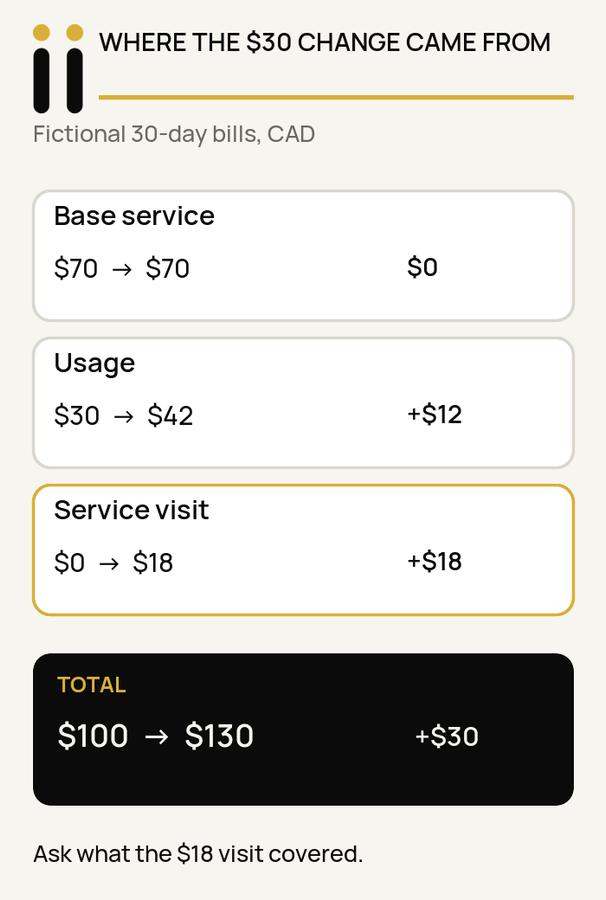
Here is a fictional example in Canadian dollars. Both bills cover a 30-day period for the same household service; there is no previous balance, payment, discount or tax in this simplified example. These are illustrative amounts, not typical prices or a claim about any provider.
- Previous bill: base service $70 + usage $30 = $100.
- Current bill: base service $70 + usage $42 + unfamiliar “service visit” $18 = $130.
- Difference: $130 − $100 = $30. Usage accounts for $42 − $30 = $12. The unfamiliar line accounts for the remaining $18.
The useful question is now narrower than “Why is my bill $30 higher?” You can ask how the $42 usage was calculated and what the $18 visit covered, including its date and the term or record the provider relies on. Even though the arithmetic balances, the example does not establish whether either charge is correct. Your own bill may also include taxes, credits, a longer billing period or a carried balance; compare those separately.
An Ontario electricity bill is a good example of why labels matter. The Ontario Energy Board's bill explainer separates Electricity, Delivery and Regulatory Charges and explains that some Delivery components are fixed while others vary with use. A change in total does not point to one cause by itself. Use the OEB page to understand those labels if your bill is for Ontario electricity; for another service or province, use that provider's bill explanation and your own agreement. Do not apply Ontario electricity categories to a phone or water bill.
Gather the records that answer your question
Save a copy of both bills before a portal replaces an older view. Keep any agreement, rate or plan notice, order confirmation, service appointment record, usage history, payment confirmation or account statement relevant to the changed line. If you think a credit or payment is missing, note its date, amount and reference from your own records.
The Office of Consumer Affairs advises keeping receipts, contracts and correspondence in a safe file, and retaining names, dates and key points from provider conversations. Share only the copies and details needed through the provider's official channel; keep your originals and a copy of what you sent.
Make a short issue log before you call or write:
- Bill date, service period, amount due and exact line label: __________
- Previous line amount and current line amount: __________
- What I have checked (agreement, usage, payment or notice): __________
- What I still need explained: __________
- Provider contact date, channel and reference number: __________
- Answer given, any promised follow-up and date to check again: __________
If the payment due date is close, ask the provider what your current payment options and account status are while the question is being reviewed. The answer depends on your account and provider; do not treat an inquiry as a confirmed extension, reversal or correction.
Ask for an explanation you can check
Use the provider's published customer-service contact route. Name the bill and line, show the comparison, and ask for a breakdown or the record behind the charge. The Office of Consumer Affairs recommends a clear, concise description and a complaint reference number when you contact a business. You can adapt this neutral message:
> Hello, I am reviewing my [bill date] bill for [service]. The amount due is [$___], compared with [$___] on my previous bill. I have identified [exact line label] at [$___], compared with [$___] previously. I checked [relevant bill, agreement or payment record], but I cannot tell [specific question]. Could you explain how this amount was calculated and what record or term supports it? If an adjustment is needed, please tell me the next step and when I should expect an update. Please give me a reference number and confirm the current due date and payment options for this account. Thank you.
For the fictional example, the specific question could be: “What service was performed for the $18 visit line, on what date, and where is that charge described in my agreement?” You can separately ask what units and price produced the $42 usage line. Avoid sending an account number, banking details or identification in an unsecured public message; use the provider's private channel when they need to locate your account.
After the reply, write down who answered, when, the reference number and what they said would happen. Compare any revised bill or credit with the original line and keep the written explanation. Check any promised adjustment in the account record or bill.
If the provider's answer does not resolve a telephone-service billing issue, the CRTC's telephone complaint guidance says to contact the telephone company first, then identifies the Commission for Complaints for Telecom-television Services (CCTS) as a next avenue. That is a telecom example, not a universal route for every household bill. For other bill types, check the applicable provider process and the Office of Consumer Affairs' roadmap for help finding the right body.
If the charge checks out but the due date is hard to manage, see how to ask for a different bill due date. If the surprise is a recurring yearly charge, use our annual-bill plan to prepare for its next date. Romii is in development; applications are not open. The optional waitlist is for updates.
Next, identify one changed line, put the relevant record beside it, and send one precise question. Keep the answer with the bill.