
An annual bill can be predictable and still catch you short. The useful question is not only “What does this cost per month on average?” It is also “How much must I set aside before the next due date?” If that date is close, the two answers can be very different.
The Financial Consumer Agency of Canada (FCAC) says a budget should include irregular expenses and that a known expense can be spread over several months so the money is there when needed. Start with one bill, its amount, its next due date and anything you have already reserved for it. Then work out a monthly amount you can actually afford.
Find the bills that do not show up every month
Look through the past year’s bills, receipts and statements for renewals and seasonal costs. An annual insurance payment, a membership renewal, school supplies or a planned holiday expense may be easy to forget during an ordinary month. Some costs are estimates rather than fixed bills. Label each one accordingly and check the current notice for the actual amount and payment date.
Keep unexpected expenses separate in your thinking. A bill with a known date and amount can have its own plan; an unforeseen car repair cannot be assigned a reliable due date. FCAC includes both periodic and unexpected costs in a budget, but the amount and timing you can predict determine which calculation is useful.
A named line in a paper budget is enough to start. Record what you set aside and avoid counting it as available for other spending.
Calculate the first due date before using a yearly average
For a bill due once a year, divide its amount by 12 to understand its ongoing monthly average. FCAC’s ongoing housing expenses worksheet uses this kind of averaging for yearly expenses over the months they cover. That figure is helpful for a full-year budget. It may be too small if you are starting partway through the year.
For the next payment, use this separate calculation:
Amount still needed = expected bill − money already reserved.
Monthly set-aside before the due date = amount still needed ÷ number of monthly deposits you can make before payment is required.
Count deposits you can make in time for the actual payment, not just calendar months until the date. If you are paid every two weeks, you can use the same idea with the number of pay deposits instead. Check when the payment must leave your account and leave room for any processing time.
Worked example: $60 on average, $180 for the first payment
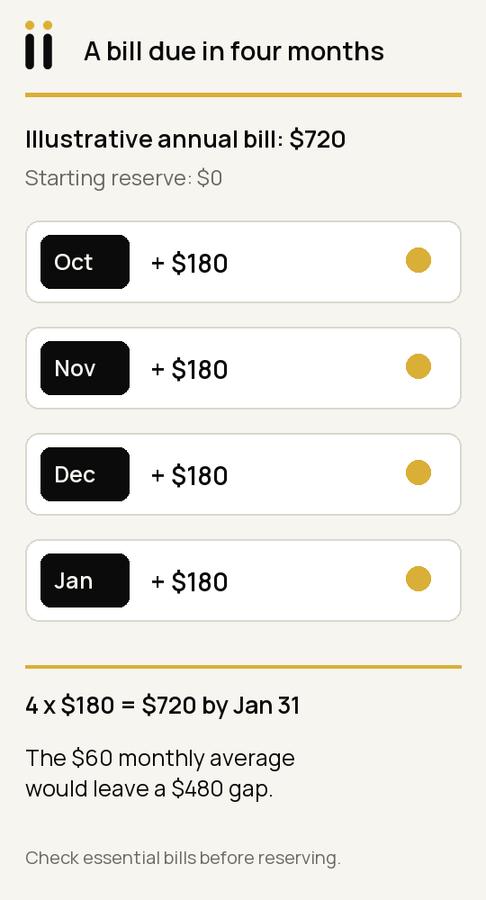
Imagine a $720 annual insurance bill due on January 31. You are making this plan on October 1, have $0 reserved for it and can set aside money on October 1, November 1, December 1 and January 1. These dates and amounts are illustrative; use your own bill and payment timing.
- Full-year average: $720 ÷ 12 = $60 per month.
- First payment: ($720 − $0 already reserved) ÷ 4 timely deposits = $180 per deposit.
- If you set aside only the average: 4 × $60 = $240 by January.
- The resulting gap: $720 − $240 = $480 short for that first bill.
After paying the January bill, 12 monthly deposits of $60 would build $720 for the following January, assuming the amount stays the same and each deposit happens before that payment is due. If the bill rises, a payment date changes or you miss a deposit, recalculate. The yearly average describes cost over time; it does not erase the first due-date gap.
Already have $240 reserved? In this same example, the remaining $480 across four timely deposits would be $120 each. Write down the opening balance before dividing. An unknown balance is not $0, and an amount assigned to another bill is not available here.
Check the plan against the rest of your budget
Add the set-asides for all your upcoming irregular bills to your regular expenses. Compare the total with money you can reasonably expect to have after essentials and required payments. FCAC’s budget guidance recommends listing income, savings and expenses, then updating the budget when amounts change.
If the first-deadline amount does not fit, record the shortfall rather than pretending the yearly average will cover it. Look at which expense is optional, whether its timing or amount can change, and what money is genuinely available. For a required bill, contact the provider ahead of the due date to ask what options, if any, apply to your account; do not assume a request changes the current payment terms. The plan should still show the original due date until you have confirmation.
Review the list when a new notice arrives and compare estimated amounts with what you actually paid. That improves next year’s estimate.
Copy this blank worksheet into a notebook
This is a manual checklist you can copy or print from this article. It is not an automatic calculator or a downloadable file. Make one copy of the fields below for each bill. Leave unknown amounts blank until you verify them; do not enter zero just to fill a space.
- Bill or planned cost: __________________
- Next amount: $__________ Estimate or confirmed? __________
- Due date: __________ Date payment must leave your account: __________
- Amount already reserved for this bill: $__________
- Timely deposits left before payment: __________
- Amount still needed (bill minus reserved): $__________
- Amount to set aside per deposit: $__________
- Next notice or timing check date: __________
For each bill, confirm the amount and date from the latest bill; subtract only money genuinely reserved for that cost; divide by deposits you can make before payment is needed; and compare the result with your available budget. Mark a date to revisit the row when the next notice arrives. If your estimate or timing changes, update the amount per deposit rather than waiting for the bill to surprise you.
For the separate task of matching monthly bills to paycheques, see our biweekly pay guide. If the issue is simply seeing when money arrives and leaves, use our payday bill calendar.
If you want optional launch updates, you can join Romii’s waitlist. Applications are not open yet. You can use the checklist above without joining.