
To compare ways to borrow $300, put each option on the same starting amount and ask two questions: How many dollars will I pay to clear it? and what will be left for essentials on every repayment date? A lower first payment can leave a balance accruing interest. A lower total cost can still demand more cash than you have on the first due date.
Start with the actual amount you need and the date you need it. Check whether you can avoid borrowing by waiting, using money already available, or asking a bill provider about a different arrangement. An arrangement is useful only if the provider confirms its terms. Our guide to asking for a different bill due date covers that separate conversation.
Start with the same $300 need, then note each payoff date
For each offer, write down how much cash you would actually receive. If a fee is withheld from a stated $300 advance, you would receive less than $300; that offer does not yet meet a $300 need. Ask what principal would be needed to receive the full amount and what that would cost. Include a fee paid separately in your total outflow, but do not count a fee twice if it is already in the scheduled payments.
Choose a common observation window, such as the next 28 days, and record every required payment amount and date within it. Note when each balance actually reaches zero. If one option clears earlier, say so; do not present its dollar cost as though both debts lasted the same number of days. When possible, ask each provider for the cost of clearing its balance on a shared date, using written terms. A fixed instalment loan generally has a stated schedule; a payday loan's short repayment terms and charges differ; a line of credit or cash advance may keep accruing interest until paid. An interest rate alone cannot tell you the dollar cost without the amount, fees, payment pattern and time outstanding. Check the written terms for the offer available to you.
The Financial Consumer Agency of Canada (FCAC) gives an illustrative comparison for $300 borrowed for 14 days and paid on time: $5.92 for a line of credit, $7.42 for overdraft protection, $7.65 for a credit card cash advance and $42.00 for a payday loan. Those figures use the agency's stated example rates and fees; they are not today's quotes, a ranking of available offers or a promise that you qualify. The example is valuable because it fixes the amount and period. Your agreement may have different charges, payment dates and repayment rules. FCAC's personal-loan guide also shows how a longer term can lower each payment while increasing the total amount paid.
A $300 example: the cheapest total may not fit payday
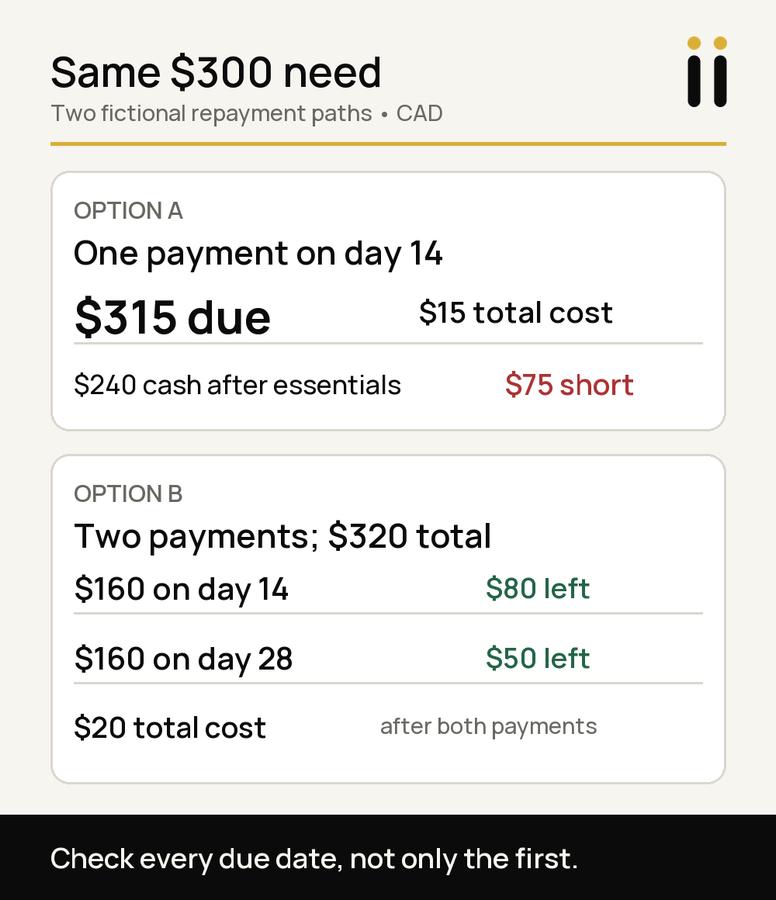
Here is fictional arithmetic, not a provider quote or a typical Canadian rate. Both options put exactly $300 in your hands today; compare their payments over the next 28 days. Option A clears on day 14, while Option B clears on day 28, so these are different borrowing durations. Option A requires one $315 payment in 14 days, so its total borrowing cost is $15. Option B requires $160 in 14 days and $160 in 28 days: $320 repaid in all, or $20 above the $300 received. Assume these are the complete on-time payments, with no separate fees, rate changes or other borrowing.
- Option A: Receive $300; pay $315 on day 14; total repaid $315; cost $15.
- Option B: Receive $300; pay $160 on day 14 and $160 on day 28; total repaid $320; cost $20.
Now suppose that, after income arrives and unavoidable housing, utilities, food, transport and existing debt payments are set aside, you have $240 available on day 14 and $210 available on day 28. Option A leaves you $75 short on day 14 ($240 − $315). Option B leaves $80 on day 14 ($240 − $160) and $50 on day 28 ($210 − $160). Option A costs $5 less in total under these different payoff schedules, but its day-14 payment does not fit this fictional cash picture. That dollar difference alone is not a rate comparison for equal borrowing time. If only $130 remained on day 28, Option B would leave a $30 shortfall then. A smaller first payment has not solved the problem if the later payment cannot be made.
Before treating any remaining amount as spare money, check when essential payments actually leave your account and whether another payment is already pending. Use our payday and bill calendar if the dates are hard to see. This example excludes late charges, changes in income or expenses, optional services and any effect on existing debts. Actual terms control.
Ask what remains after the minimum payment
For a line of credit, FCAC says interest generally runs on the amount borrowed until the balance is repaid, and the required minimum payment may be only the interest. Paying that minimum can leave the principal outstanding. A credit card cash advance has no interest-free grace period; interest begins when you take it. Overdraft protection can have a fee as well as daily interest, and a deposit may automatically reduce the negative balance. These structures cannot be treated as a fixed two-payment loan just because this month's required payment looks smaller. See the agency's guides to lines of credit, credit card cash advances and overdraft protection.
Ask the provider for the rate and all applicable fees, how the balance and interest are calculated, the minimum due, what remains after that payment, and the cost if you clear the balance on your chosen date. If the rate is variable or the payoff date is uncertain, write the total as unknown, then ask for a calculation based on your proposed payments. A minimum due is a payment obligation, not the full price of borrowing.
Bring two real offers onto one page
Use the free, fillable borrowing comparison worksheet (PDF) to record two offers side by side. It asks for the amount needed, net cash received, rates and fees, payment frequency, total payments, first-payment timing and unanswered terms. For this example, set the comparison period to 28 days, then write that A clears on day 14 and B on day 28. The PDF is a manual offer-recording sheet: it does not calculate total cost or provide separate boxes for every due date and cash left after essentials. Save it locally or print it; no sign-in or personal account details are needed.
Beside the worksheet, copy one line for every expected payment or automatic withdrawal: “Date: ___; cash available after essentials and existing obligations: $___; payment: $___; cash remaining: $___.” Then use these four checks before you agree:
- Cash received: What lands in your account after any deduction? Does it cover the same $300 need?
- Full dollar cost: Add all payments and any separately paid required charges, counting each charge once; subtract the cash actually received. For an open balance, specify the payoff date and mark any unknown rate, fee or balance.
- Repayment pressure: On each payment or expected withdrawal date, subtract the amount from cash available after essentials and existing obligations. A negative result means the assumed plan has a gap.
- Unanswered terms: Ask about optional add-ons, missed payments, prepayment, cancellation, credit inquiries and the written terms. Do not enter zero where the answer is unknown.
The FCAC's before-borrowing checklist says to review affordability, fees, repayment terms and what happens if you miss a payment. If the figures depend on another loan to make the next payment, pause and seek a different plan or qualified debt help before committing. If no option fits both the full cost and the payment dates, that is useful information: it is better to find the gap before signing than after the money is due.
Romii is in development. Applications are not open. This guide is educational and does not compare Romii terms or recommend a lender.