
An NSF fee can follow a payment your bank returns because your account could not cover it. If you see one, check whether the payment went through, whether the biller will retry it, and whether you still owe the bill. Then review the bank fee separately. Since March 12, 2026, a federally regulated bank can charge no more than $10 for an NSF fee on a personal deposit account, subject to the rules below. That cap does not erase the unpaid bill or a separate charge from the biller. Source: Financial Consumer Agency of Canada (FCAC).
First, find out what happened to the payment
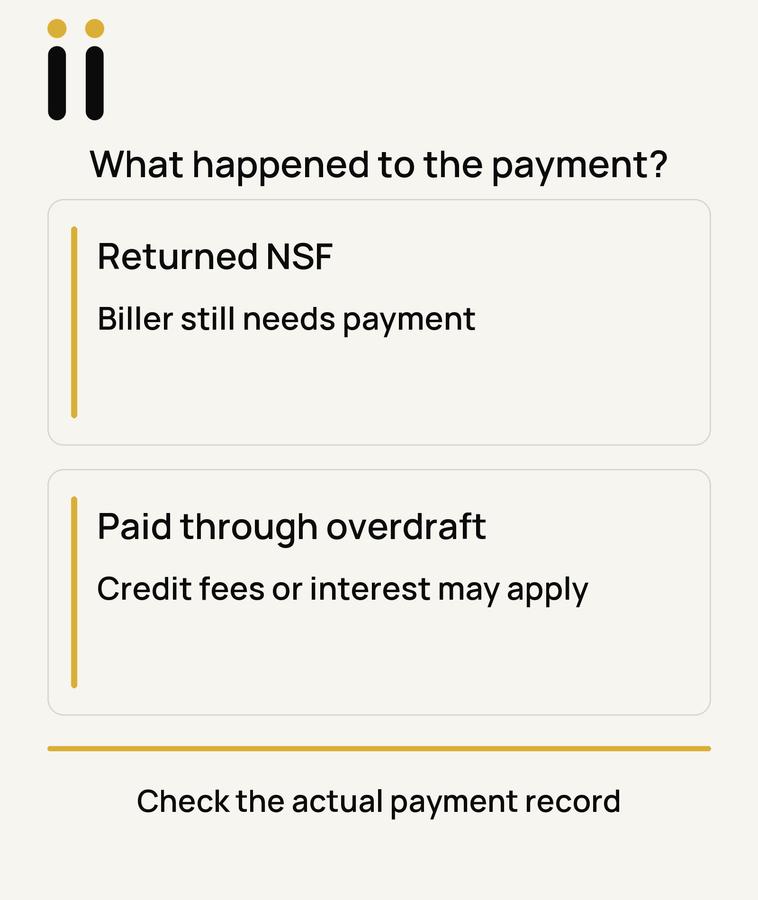
NSF means non-sufficient funds. It commonly describes a cheque or pre-authorized debit (PAD) returned because there was not enough available money in the account. Look at the bank transaction and the biller's payment record. A returned payment and a successful payment are different outcomes; a bank fee on its own does not tell you whether the biller has been paid.
Check the payment date, account, amount, and any bank notice. If the amount looks wrong, check the bill; for recurring timing surprises, map your payday and bills.
An arranged overdraft works differently: it is credit that may let a payment go through when the account balance is short. It can carry interest and fees, has a limit and eligibility conditions, and a payment above that limit may still fail. Do not assume overdraft is cheaper for your situation just because an NSF fee is capped. Source: FCAC on overdraft protection.
Why it can happen when you thought there was enough money
A balance can look sufficient while the amount available for that payment is different. Check these possibilities against the transaction dates and account records:
- Did the debit arrive before pay or another deposit became available?
- Was a recently deposited cheque still on hold? A displayed balance can include a cheque the bank has not yet made available. Source: FCAC on cheque holds.
- Did another debit use the available money first?
- Was the bill higher than usual, or did it draw from a different account than expected?
These are checks, not a finding about why your payment failed. If the records do not explain it, ask the bank which balance and account it used when the payment was presented.
Check whether the bank's $10 rule applies
The federal NSF rules apply to deposit accounts held by a natural person for personal use, including joint personal accounts, at federally regulated banks. They set a maximum, not a mandatory fee. Source: current consolidated regulations, section 10.1. FCAC summarizes the bank fee limits in its chequing-account guidance. For a current bank example, RBC lists a $10 NSF fee, subject to its stated restrictions. Your own account agreement and transaction record still matter. Source: RBC additional account services.
- Covered personal account at a federally regulated bank: The bank's NSF fee is at most $10.
- Another NSF event on the same account within two business days: The bank cannot charge the NSF fee more than once in that period. Check the transaction dates and your statement.
- Unauthorized overdraft of less than $10: The bank cannot charge an NSF fee for that event. The wording is less than $10, not “$10 or less”; do not use the payment amount alone to decide whether this exception fits.
- Business or corporate account, or an account at a provincially regulated credit union: This particular federal bank cap does not set that provider's fee. Check its terms and applicable rules.
- Separate returned-payment charge from the biller or lender: The bank cap does not cap that separate charge; check the biller's agreement and the itemized amount.
Settle the bill without paying twice
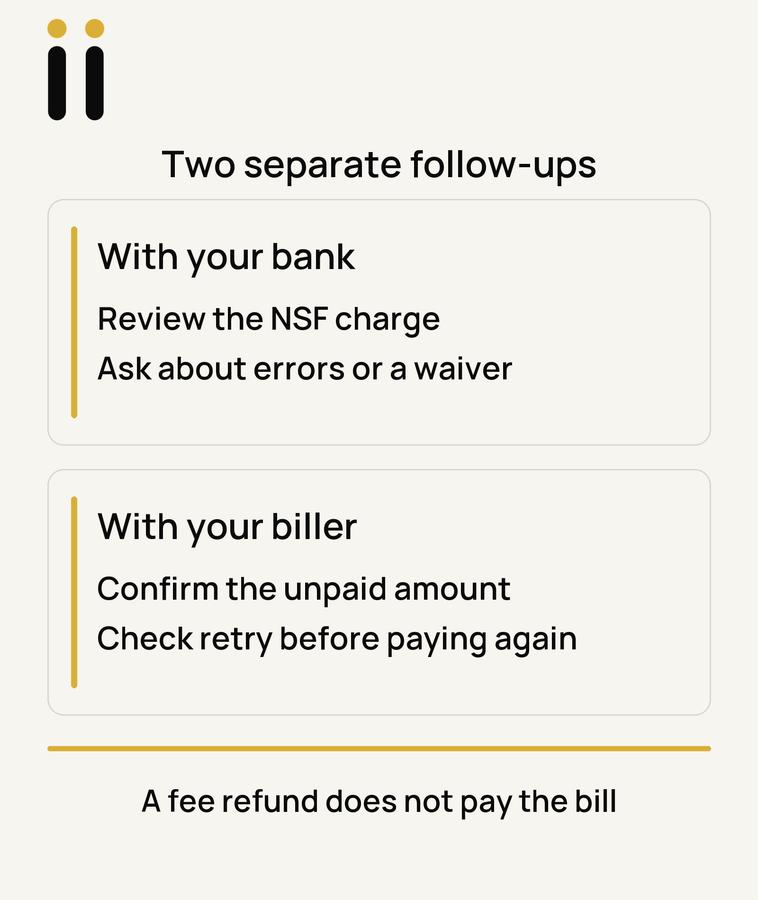
If the payment was returned, contact the biller and ask: Is the bill still outstanding? Will you retry the debit, and when? Is there a separate returned-payment charge? Do this before sending a replacement payment. For a PAD returned for insufficient funds, Payments Canada permits the biller to retry once within 30 days, for the same amount. A retry and a manual payment close together could create a duplicate payment or another shortfall. Source: Payments Canada PAD consumer guide.
If the biller confirms it will not retry, arrange a payment method and timing you can actually cover. If it will retry, check available funds for that date and ask how it will handle a payment you have already made. Save the reply, payment confirmation, and statement entry. A recurring charge to a credit card is not a PAD, so ask the card issuer and biller about that transaction's process instead of applying the PAD retry rule.
Cancelling a PAD does not cancel the underlying contract or the amount owed. Give the biller written cancellation instructions if you intend to stop future PADs, and check your bank's stop-payment process, timing and possible fee if you need to prevent a specific debit. Keep the records. Sources: Payments Canada and FCAC on PADs.
Ask the bank to review a fee that looks wrong
Compare the fee with the fee rules above, your account type, and the dates of any other NSF fees. Tell the bank which transaction you are questioning and why; request an itemized explanation or reversal. You can also ask for a discretionary waiver if an otherwise valid fee caused difficulty, but a waiver is not guaranteed. A biller's returned-payment charge needs a separate conversation with the biller.
If the PAD itself was incorrect or unauthorized, contact your bank promptly. For a personal PAD, FCAC describes a usual 90-calendar-day period to report the problem and seek reimbursement, with exceptions for some fund transfers. Ask the bank about reversing any additional charges that resulted. This process addresses an incorrect or unauthorized PAD; it is not a general 90-day right to an NSF-fee refund. Source: FCAC on PAD problems.
For a complaint about a federally regulated bank, record the date you first complained and keep the bank's response. The bank must provide a detailed written response within 56 calendar days. You can take the complaint to the Ombudsman for Banking Services and Investments (OBSI) if more than 56 days have passed since your initial complaint or the bank has issued its written response and closed the file. FCAC explains the process but does not resolve individual refund disputes. A provincially regulated credit union has a different complaint path. Use FCAC's complaint guide for the current steps.
Prevent the next returned payment
Put each recurring debit date beside the date money actually becomes available, allowing for any deposit hold. Keep a small cushion if possible, and review the amount when a bill changes. For bills that vary, compare automatic payments with reminders before choosing how to track them. If the timing repeatedly misses your pay cycle, ask whether the biller can change the due date. The immediate aim is to confirm the bill, the retry plan, and the funds available on the payment date.
Romii is being built in Ontario for small, temporary cash-flow gaps. It is Coming Soon and applications are not open. If you want launch updates, you can join the optional waitlist; the steps above work without joining.
Rules and fees checked on October 7, 2026. Verify your provider's current terms and the official rules before relying on a fee amount or complaint deadline.
Related articles
- Make a payday and bill calendar if the payment keeps landing before your next deposit.
- Choose between automatic payments and reminders if you need more control over a changing bill.
- Check a bill that looks wrong before replacing a returned payment for a disputed amount.
Sources & further reading
- Financial Consumer Agency of Canada — New NSF fee regulations bring down cost of banking for Canadians
- Canada Gazette — Regulations Amending the Financial Consumer Protection Framework Regulations, section 10.1
- RBC Royal Bank — Additional Account Services
- Payments Canada — Pre-authorized debits consumer guide
- Financial Consumer Agency of Canada — Pre-authorized debits
- Financial Consumer Agency of Canada — File a complaint about a financial institution
- Financial Consumer Agency of Canada — Overdraft protection
- Financial Consumer Agency of Canada — Cashing a cheque
- Financial Consumer Agency of Canada — Chequing accounts
- Financial Consumer Protection Framework Regulations — current consolidated text, section 10.1